Snowboarding in Canada: Regions, Passes and Trip Planning
Canada runs from Whistler's huge terrain to Revelstoke's big vertical, Banff's national park resorts and Quebec's smaller mountains. Here is how to choose a region and plan the trip.
Canada offers some of the most varied snowboarding in North America. On the Pacific side, Whistler Blackcomb is one of the largest ski areas on the continent. Inland, British Columbia’s Interior ranges hold the long vertical of Revelstoke and a loose chain of powder-focused resorts known as the Powder Highway. Over the Continental Divide in Alberta, three resorts sit inside Banff National Park. And in Quebec, smaller mountains sit close to historic cities and a different culture.
This guide sorts those regions, explains which multi-resort passes work in Canada for 2026–27, and covers the logistics that matter for visitors: airports, winter driving, entry rules and money. Prices are approximate and in the currency noted, so confirm them with each resort before you book.
The main snowboarding regions
Whistler Blackcomb, British Columbia
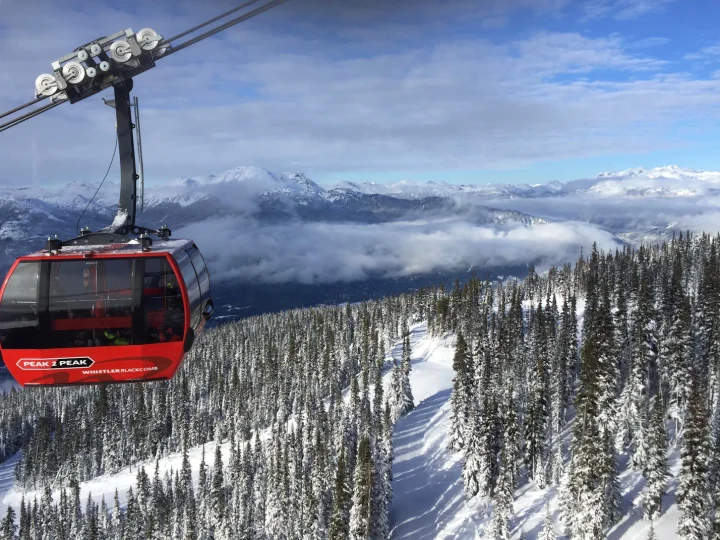
Whistler Blackcomb is the headline resort. The resort lists about 8,171 skiable acres across two mountains, more than 200 marked runs, 16 alpine bowls, three glaciers, 36 lifts and an average of about 422 inches (1,072 cm) of snow a year. The PEAK 2 PEAK Gondola connects the two mountains. Vancouver International Airport (YVR) is about a two-hour drive away on the Sea to Sky Highway, and the resort lists bus and shuttle options for travelers without a car. See our Whistler Blackcomb snowboarding guide for terrain, lodging and costs.
Revelstoke and the BC Interior
Revelstoke is the vertical-drop story. The resort lists a descent of 1,713 meters (about 5,620 feet), which Ikon describes as the most in North America, and about 3,121 acres, 75 runs and an average of 10.5 meters of snow a year. Its terrain is split roughly 12% green, 43% intermediate and 45% advanced, and the resort lists the Revelation Gondola plus the Stoke, Ripper and Stellar chairs. Kelowna International (YLW) is about 119 miles away and Calgary International (YYC) about 268 miles, according to Ikon. Our Revelstoke snowboarding guide goes deeper.
The Powder Highway
The Powder Highway is a circular winter route through British Columbia’s Kootenay Rockies. According to the route’s own website, it links eight alpine resorts (Kicking Horse, Revelstoke, Kimberley, Fairmont Hot Springs, RED Mountain, Whitewater, Fernie and Panorama), 14 cat-skiing operators and 22 backcountry lodges, with towns such as Fernie, Nelson, Rossland, Golden, Revelstoke and Invermere along the way. For snowboarders, it works as a themed road trip: build an itinerary around two or three resorts rather than trying to see everything. The website does not list airports, so plan the route around the Calgary, Kelowna or Vancouver airports and allow plenty of driving time.
Backcountry and cat-skiing operations carry real avalanche risk. Use certified guides and read our snowboard safety tips before heading out of bounds.
Banff, Lake Louise and SkiBig3
Alberta’s three Banff National Park resorts, Banff Sunshine, Lake Louise Ski Resort and Mt Norquay, sell lift tickets together as SkiBig3. Sunshine sits on the Continental Divide, Lake Louise has about 4,200 acres, and Norquay is roughly seven minutes from the town of Banff, per SkiBig3. This season Lake Louise opened on November 1, with Banff Sunshine and Mt Norquay scheduled for November 6. Free ski shuttles run between the resorts and town. Calgary International is about 130 km (87 miles) from the park, a drive of about 90 minutes, and everyone visiting Banff or Lake Louise needs a national park pass, which the tourism office suggests buying online before you arrive. Read the Banff snowboarding guide for details.
Quebec and Eastern Canada
Quebec’s mountains are smaller than those in the West, but they have a distinct culture. Tremblant lists a 2,116-foot vertical drop, 102 trails and 762 acres, with an average of 192 inches of snow, and sits about 85 miles from Montreal–Trudeau (YUL). Le Massif de Charlevoix has about 770 meters of vertical and is roughly 1.5 hours from Quebec City, with the mountain dropping toward the St. Lawrence River. The Epic Pass includes Mont-Sainte-Anne and Stoneham as partner resorts, and Ontario’s Blue Mountain is unlimited on the Ikon Pass.
How to choose
| Region | Anchor resorts | Gateway airport | Pass links | Character |
|---|---|---|---|---|
| BC coast | Whistler Blackcomb | Vancouver (YVR), about 2 hours | Epic Pass | Huge terrain and a large resort village |
| BC Interior | Revelstoke, Fernie, Kicking Horse, Panorama, RED | Kelowna, Calgary, Vancouver | Ikon, Epic partner days, Mountain Collective | Big vertical, deep snow, road-trip style |
| Alberta Rockies | Banff Sunshine, Lake Louise, Mt Norquay | Calgary (YYC), about 90 minutes | Ikon, Mountain Collective | National park setting, town of Banff |
| Quebec | Tremblant, Le Massif, Mont-Sainte-Anne | Montreal (YUL), Quebec City | Ikon, Mountain Collective, Epic partner days | Smaller vertical, French-speaking province |
If you want the biggest single resort, choose Whistler. If long runs and deep snow matter most, look at Revelstoke or the Powder Highway. If you want a scenic town and national park setting with short transfers from a major airport, choose Banff. If your trip is part city break, part snowboarding, look at Quebec. You can compare resorts side by side in our tool.
Passes that work in Canada
- Epic Pass: Whistler Blackcomb is part of the Epic network, which Epic’s site describes as unlimited access at Vail Resorts mountains. Epic Pass holders also get up to seven days combined at Fernie, Kicking Horse, Kimberley, Mont-Sainte-Anne, Nakiska and Stoneham. OnTheSnow’s pass guide says the cheaper Epic Local Pass limits access at Whistler Blackcomb to a set number of days, so check the Local Pass terms before you buy.
- Ikon Pass: Tremblant and Blue Mountain (Ontario) are unlimited. Revelstoke, SkiBig3, Sun Peaks, Panorama, RED Mountain, SilverStar, Cypress and Le Massif de Charlevoix are up to seven days each, and Grouse Mountain is a two-day bonus. Ikon Base and Session passes have fewer days.
- Mountain Collective: Two days at each of 27 destinations, with 50% off additional days. Canadian options include Banff Sunshine, Lake Louise, Revelstoke, Panorama, Sun Peaks, Marmot Basin, Le Massif de Charlevoix and Bromont.
Check official pass pages for current resort lists, day limits and reservation rules. Our snowboarding in the USA guide explains the networks in more detail.
When to go
Whistler describes December through March as peak ski season. SkiBig3 resorts have already begun to open for 2026–27, with Lake Louise opening on November 1 and the other two scheduled for November 6. Opening dates in the BC Interior and Quebec vary by resort, so check each one. For bigger snow totals, plan for the heart of winter; for fewer crowds, consider early or late season on a resort with reliable coverage. Holiday weeks, such as Christmas and New Year, are the busiest and most expensive.
Travel logistics
Entry and documents
The Canadian government says US citizens are exempt from the eTA requirement and should carry proper identification such as a valid US passport. Visa-exempt foreign nationals flying into Canada need an eTA, which the government lists at CAN$7 and which requires a valid passport, a credit or debit card and an email address. Check the government site for your nationality before you book.
Getting around
Whistler is about 120 km (75 miles) north of Vancouver, roughly a two-hour drive, and the resort lists bus and shuttle services. In the Sea to Sky corridor, police and traffic services conduct random winter tire checks from October to April; vehicles need winter tires with the mountain-snowflake symbol or an M+S rating, or must carry chains. BC highways have their own seasonal tire rules, so check the province’s DriveBC page for the specific route you plan to drive. In Banff, SkiBig3 runs free ski shuttles between its resorts and the town. In Quebec, check shuttle and rental-car options from Montreal or Quebec City.
Money and insurance
Canadian resorts typically quote prices in Canadian dollars, and exchange rates move, so allow a buffer. Check your travel insurance covers winter sports, on-mountain rescue and medical care; see snowboard travel insurance. For flights with a board, see how to fly with a snowboard.
What to pack
Interior BC and the Rockies can be cold, and Quebec winters can bring low temperatures. A warm face covering and insulated layers help, and a wheeled bag keeps airport transfers simple.
See Available Options (opens Amazon search for snowboard balaclava face mask in a new tab) View on Amazon (opens Amazon search for padded snowboard travel bag with wheels in a new tab)Use the packing checklist below for the rest.
Pros and cons
Pros
- Huge variety: coast, interior, Rockies and Quebec
- Large vertical drops (Revelstoke lists 1,713 meters)
- Strong pass links, including Epic at Whistler and Ikon across the interior
- Scenic mountain towns with national park settings
Cons
- Distances between regions are large, so you usually pick one
- Winter driving rules and mountain roads need preparation
- Some passes give only limited days at Canadian resorts
- Prices are in Canadian dollars, with exchange-rate risk
Frequently asked questions
Where is the best snowboarding in Canada?
It depends on what you want. Whistler Blackcomb is the largest resort, Revelstoke has the most vertical, Banff offers a national park setting, and Quebec offers smaller mountains with a different culture.
Do I need a visa or eTA for a Canadian snowboard trip?
US citizens do not need an eTA but should carry a valid passport. Other visa-exempt visitors flying in need an eTA. Check the Canadian government website for your situation.
Can I use my Epic Pass in Canada?
Yes. Whistler Blackcomb is part of the Epic network, and Epic Pass holders get up to seven combined days at the Canadian partner resorts listed on the Epic site. Check the Epic Local Pass terms separately, because they differ.
Can I use my Ikon Pass in Canada?
Yes. Ikon includes Tremblant and Blue Mountain as unlimited, and seven days at resorts including Revelstoke and SkiBig3. Ikon’s Base and Session passes have fewer days.
What is the Powder Highway?
It is a route through British Columbia’s Kootenay Rockies linking resorts, cat-skiing operators and backcountry lodges, according to its official website.
How far is Whistler from Vancouver?
About 120 km (75 miles) by road, roughly two hours depending on traffic and conditions, according to the resort.
Related guides
- Whistler Blackcomb snowboarding guide: terrain, lodging and costs at Canada’s biggest resort.
- Revelstoke snowboarding guide: big vertical and deep interior snow.
- Banff snowboarding guide: SkiBig3 and the national park setting.
- Snowboarding in the USA: the neighboring option, with its own regions and passes.
- Japan versus Canada for a wider view.
Sources and further reading
- Mountain stats — Whistler Blackcomb
- Getting here — Whistler Blackcomb
- Mountain stats — Revelstoke Mountain Resort
- Revelstoke Mountain Resort — Ikon Pass
- Tremblant — Ikon Pass
- Ikon Pass 2026/27 — Ikon Pass
- Mountain Collective 2026/27 — Mountain Collective
- Resorts of the Canadian Rockies — Epic Pass
- SkiBig3 — SkiBig3
- Getting here — Banff and Lake Louise Tourism
- The Powder Highway — Kootenay Rockies
- Le Massif de Charlevoix — Le Massif de Charlevoix
- 2026/27 Epic Pass buyer’s guide — OnTheSnow
- Electronic Travel Authorization — Government of Canada
- eTA facts — Government of Canada
- Winter tires — DriveBC