How to Fly With a Snowboard: Airline Rules, Packing and Claims
How airlines count a snowboard and boot bag, where weight limits sit, and how to pack and claim if something goes wrong, with four airlines' published rules as of November 2026.
Flying with a snowboard is routine for airlines, but the details that decide your bill and your board’s condition vary from carrier to carrier: how the board bag and boot bag are counted, where the weight line sits, and how the packaging is described. A few minutes of checking before you book can save you a surprise at the check-in counter.
This guide explains how airlines generally handle snowboards, summarizes the published rules of four carriers as they read at the time of writing (November 2026), and covers packing, weight and what to do if something goes wrong. Policies and fees change often, so use this as a map and confirm the details on your own airline’s website before you travel.
How airlines count a snowboard
In the policies reviewed, a snowboard in a travel bag counts as one checked bag, and a boot bag is handled alongside it. The details are where airlines differ, so the table below summarizes what each one publishes.
| Airline | What counts as one item | Fees and weight (as published, November 2026) | Packaging wording |
|---|---|---|---|
| Delta | One snowboard bag plus one boot bag per person. Their combined weight is measured against the standard allowance for your cabin. | Standard checked-bag fees apply by cabin and region. An excess-weight fee applies when the combined weight is over 50 lb. Items over 115 linear inches (292 cm) are not accepted. | Sports equipment must be in a durable protective container designed for it. |
| Air Canada | One snowboard bag (holding one or more boards) counts as one checked bag. One boot bag per passenger does not count as a bag if it travels with the board and holds only equipment such as boots, a helmet and goggles. | No oversize charge, but overweight charges apply. On Canada–Europe, Middle East and Africa trips operated by Air Canada, Austrian, Brussels Airlines, Lufthansa or Swiss, a board plus a boot bag can travel on top of the regular allowance on every fare except Economy Basic. | A rigid and/or hard-shell case designed for shipping. Sports-equipment bags can’t contain clothing or other personal items. |
| WestJet | One set per guest: a snowboard and boots. | The oversize bag fee is waived. Extra-piece and overweight fees still apply. Sports items can be up to 3 m (118 in.) long. | Packed for shipping to prevent damage. |
| JetBlue | One snowboard (or one pair of skis) with one pair of boots, packed in a suitable container, counts as one bag toward the included allowance. | Baggage of 51–99 lb carries a $150 excess-weight charge per piece (per the Contract of Carriage, revision dated April 17, 2026). Bags of 100 lb or more are not accepted. | Sporting equipment must be properly packed in an appropriate hard-sided container. |
Weight, size and fees
Weight matters more than size for most boards. A board bag plus boots, helmet and a few soft items can creep past 50 lb (23 kg) faster than you would expect, and that is the point where Delta and JetBlue start charging for excess weight. Delta applies the 50 lb check to the board bag and boot bag combined.
On the base fee, the published examples vary:
- Delta: its page says standard checked-bag fees apply to skis and snowboards. Its fee table lists $45 for a first bag and $55 for a second bag each way on U.S. domestic Main and Delta Comfort tickets, without status or card benefits (as of November 2026).
- JetBlue: the Contract of Carriage lists off-peak fees of $49 for a first checked bag and $69 for a second on certain fares bought on or after March 27, 2026, and points to its website for peak-season pricing.
- WestJet: sporting equipment is subject to standard checked-baggage fees, which vary by fare and are listed on its fees page.
- Air Canada: on the qualifying Canada–Europe, Middle East and Africa itineraries above, a board and boot bag travel in addition to your normal allowance. Elsewhere, the board counts as a checked bag.
Fees can also differ by route, fare class and loyalty status, so price your actual itinerary. If you are weighing the cost of bringing a board against renting one, see rent or bring your own snowboard and our snowboard holiday cost breakdown.
Choose and pack the bag
Luggage maker Travelpro advises a well-padded bag with room for the board, boots and bindings, and notes that airlines may not compensate for damage if the board was not properly protected. Burton and Db Journey, both of which make snowboard gear and bags, give similar advice: a fully padded travel bag, with extra protection around the bindings and edges.
Because airline wording ranges from “protective container” to “hard-sided container,” check whether your airline’s policy specifies a type. If the wording is stricter than your bag, ask the airline how it treats padded soft bags before you travel. Our snowboard travel bag guide compares options.
See Available Options (opens Amazon search for padded snowboard travel bag with wheels in a new tab)For the packing sequence itself, see how to pack a snowboard bag. The short version from the manufacturer guidance:
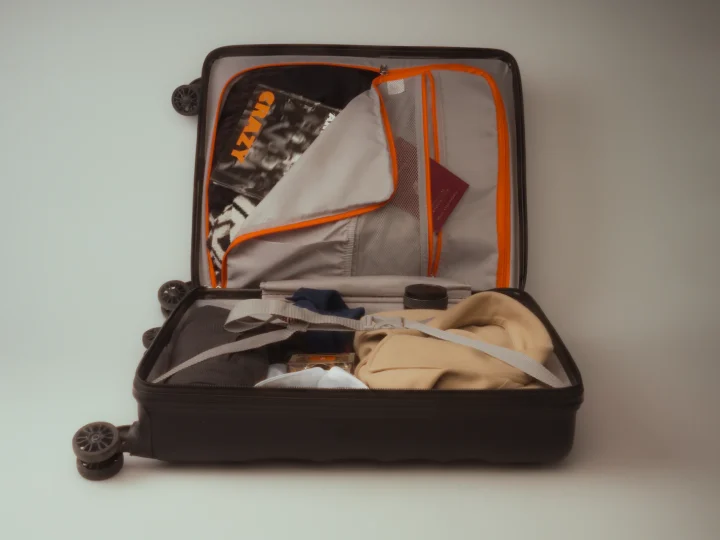
- Pad the bindings, nose and tail. If you leave bindings on, fold the highbacks down and tighten the straps over something soft; removing them is another option.
- Cover sharp edges so they cannot cut the bag or other gear. Burton suggests taping cardboard over them.
- Weigh the packed bag at home, using a luggage scale or the bathroom scale method (weigh yourself holding the bag, then subtract your own weight).
- Put a luggage tag with your name, phone and email on the outside and inside.
- Check whether your airline allows clothing or other non-equipment items in the board bag. Air Canada does not, and Travelpro notes that airlines may remove clothes during inspection.
At the airport
- Pay ahead if you can. Delta, for example, lets you pay for bags on its website or app during the 24-hour check-in window.
- Allow extra time. Burton suggests arriving two hours early for domestic flights and three hours for international ones.
- Keep a backup kit in your carry-on. Travelpro suggests carrying boots, helmet and goggles on board if you are worried about delayed bags.
- Consider TSA-approved locks. Burton recommends them for bags that may be opened for inspection.
- Keep your baggage claim tags until the bag is in your hands.
If your gear is damaged, delayed or lost
Report the problem to the airline as soon as you notice it, and file a claim promptly; the U.S. Department of Transportation (DOT) advises filing a baggage claim as soon as possible. Airline deadlines differ, so check yours.
A few points worth knowing:
- Photograph the bag and board before check-in. Burton suggests this in case you need to file a damage claim. Note serial numbers of valuable items too.
- Liability has a floor, not a guarantee of full value. Federal rules (14 CFR Part 254) say airlines cannot limit domestic baggage liability to less than $4,700 per passenger, a figure effective January 22, 2025 that DOT reviews every two years. International trips fall under different liability rules.
- Exclusions exist. DOT’s guidance notes that airlines are generally not responsible for pre-existing damage or damage caused by improper packing.
- Valuable kit may need extra cover. DOT suggests asking the airline about excess valuation coverage, or buying separate travel insurance, if your bag’s value exceeds the liability limit.
For what policies typically cover for equipment and rescue, see snowboard travel insurance: what to check. This is general information, not insurance or legal advice.
Pre-flight checklist
- Read your airline’s sporting-equipment page and your booking’s baggage rules.
- Confirm how the boot bag is counted and what may go inside it.
- Pad the bindings and cover the edges.
- Weigh the packed bag and the boot bag, and stay under the airline’s weight line.
- Label the bag inside and out, and photograph it before check-in.
- Pack boots, helmet, goggles and essentials in your carry-on if you want a backup plan.
- Run through the snowboard trip packing list so nothing is left at home.
Frequently asked questions
Can I take a snowboard as carry-on?
The airline pages reviewed treat snowboards as checked baggage. Air Canada’s special-items page marks carry-on as restricted for skis and snowboards, and Delta’s page describes ski and snowboard equipment as allowed as checked baggage.
Does the boot bag count as a second bag?
It depends on the airline. Delta accepts one boot bag per person alongside the board bag and measures their combined weight. Air Canada does not count a boot bag that travels with a board and holds only equipment. Check the exact wording for your carrier.
Do I need a hard case?
Not necessarily, but read the wording. Delta asks for a durable protective container designed for the equipment, while JetBlue’s contract refers to a hard-sided container. If you are unsure whether a padded soft bag meets your airline’s wording, ask before you travel.
Can I pack clothes in the board bag?
Many packing guides use soft clothing as padding, but Air Canada says sports-equipment bags can’t contain clothing or other personal items, and Travelpro notes that airlines may remove clothes during inspection. Check your airline’s rules and use dedicated padding if in doubt.
How much does it cost to fly with a snowboard?
Often the standard checked-bag fee for your fare and route, plus any overweight charge. Published examples as of November 2026 include Delta’s $45 and $55 domestic fees and JetBlue’s off-peak $49 and $69, but your actual price depends on the fare, route and date.
Sources and further reading
- Sporting equipment (ski and snowboard) — Delta Air Lines
- Baggage overview and checked bag fees — Delta Air Lines
- Special items: skis and snowboards — Air Canada
- Golf clubs, bicycles, sporting equipment — WestJet
- Contract of Carriage (revision dated April 17, 2026) — JetBlue Airways
- Lost, delayed, or damaged baggage — U.S. Department of Transportation
- 14 CFR Part 254, Domestic Baggage Liability — U.S. Government Publishing Office
- Travel hacks for flying with your skis or snowboard — Travelpro
- How to fly with a snowboard — Burton
- How to pack a snowboard bag for air travel — Db Journey