Best Snowboard Goggles: Lens Tech, VLT and 7 Picks for 2026–27
Lens categories, VLT, lens shapes and helmet fit explained simply, plus seven goggles from Smith, Anon, Sweet Protection and Atomic compared on published specs.
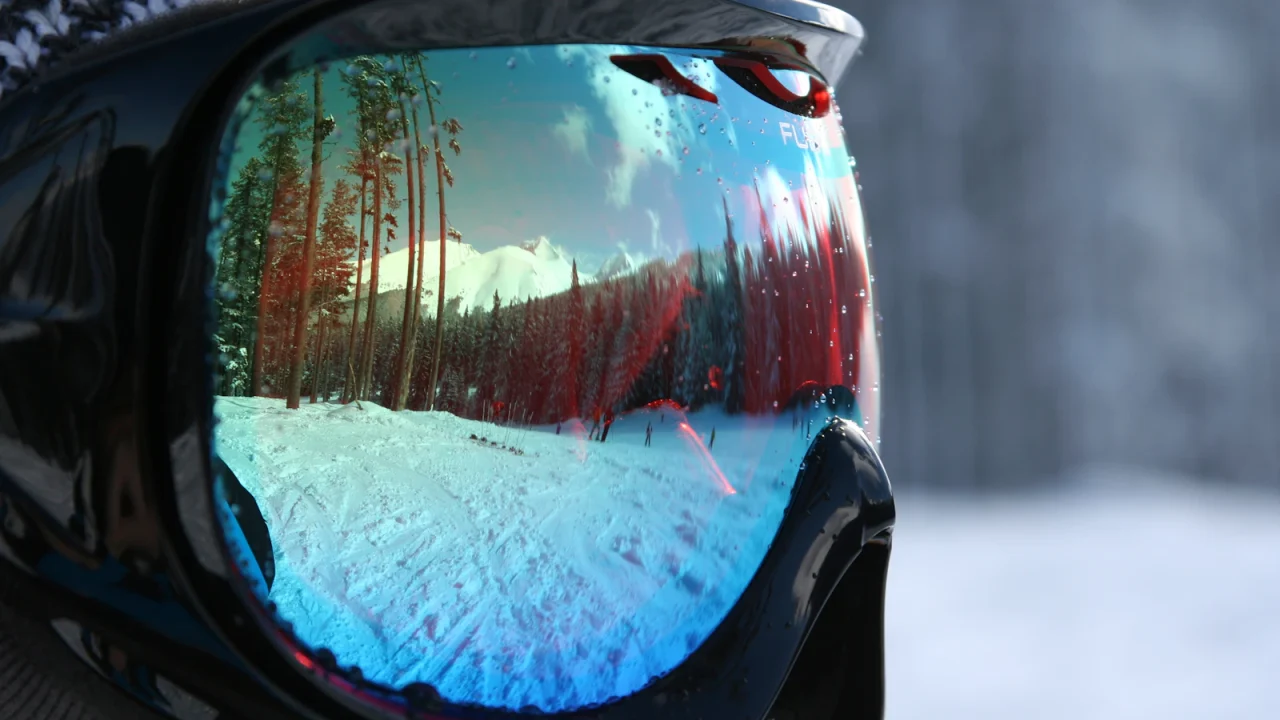
Goggles do more than keep snow out of your eyes. The right lens can help you read terrain in flat light, cut glare on a bluebird day and keep the view clear when the weather turns. Pick the wrong one and you may be squinting at rolling shadows, fighting fog or nursing a gap between helmet and goggle that leaves your forehead cold.
This guide explains lens basics in plain English, including visible light transmission (VLT), lens shape and lens-change systems, and then compares seven goggles from Smith, Anon, Sweet Protection and Atomic using what each maker publishes. Pair it with our guide to the best snowboard helmets and our list of what to wear snowboarding.
Quick picks
- Widest field of view (per Smith): Smith 4D MAG
- Best for wearing over glasses: Smith 4D MAG XL
- Semi-frameless with magnetic lens swaps: Smith Squad MAG
- Flat-toric lens with published lens VLTs: Anon M5
- Cylindrical lens with a magnetic latch: Anon Sync
- All-mountain cylindrical goggle with a stated 20% VLT: Sweet Protection Boondock II RIG Reflect
- Spherical lens with over-glasses grooves: Atomic Revent L HD
How we chose these goggles
We have not hands-on tested these goggles. Our picks come from reading each manufacturer’s official product page and comparing what is published: lens shape, lens technology, VLT where stated, lens-change system, fit options, over-the-glasses (OTG) design and helmet-pairing guidance. We favored goggles that give clear specs, and we say plainly when a page leaves something out.
We did not include prices, star ratings or scores. Pros and cons are inferred from published details, not from wearing the goggles. For example, a “con” may simply be that the maker does not list VLT numbers.
Snowboard goggle lens tech explained
What is VLT?
VLT stands for visible light transmission: the percentage of visible light that passes through the lens to your eyes. A low VLT means a darker lens for bright sun, while a high VLT means a lighter lens for cloud, snow and dusk. Many makers sort lenses into categories from 0 to 4 (shown as S0 to S4 on some goggle pages). Wikipedia’s summary of the European sunglasses standard EN 1836 lists them like this:
| Filter category | VLT range | Typical use |
|---|---|---|
| 0 | 80–100% | Fashion, indoor use, cloudy days |
| 1 | 43–80% | Low sun exposure |
| 2 | 18–43% | Medium sun exposure |
| 3 | 8–18% | Strong brightness, glare from water or snow |
| 4 | 3–8% | Intense sun, high mountains, glaciers (not for driving) |
Anon’s product pages show how this works in practice. Its “Cloudy” lenses are listed at 53% and 59% (S1), “Variable” lenses at 21% to 34% (S2), “Sunny” lenses at 14% and 17% (S3), and its Sunny Onyx lens at 6% (S4). That makes the S1 and S2 lenses the ones to reach for in flat light, and the S3 and S4 lenses the ones for bright sun. Not all brands list VLT: Smith’s pages for the goggles below name their lenses (for example ChromaPop Sun or Everyday) without publishing percentages.
Photochromic, mirrored and polarized lenses
Photochromic lenses change their tint with light, which suits days when the sun comes and goes. Smith offers ChromaPop Pro Photochromic options on the 4D MAG, 4D MAG XL and Squad MAG. Mirror coatings add a reflective finish to the outer surface, and the names of Smith’s and Anon’s lenses often include the mirror color. Anon also lists polarized lens options on some models. Whichever you choose, the lens category tells you more about brightness than the color does.
Lens shapes: cylindrical, toric and spherical
Anon describes its cylindrical goggles as curved horizontally only, which gives a flatter, more retro look. Spherical lenses curve both ways, and Atomic says the spherical lens on its Revent widens peripheral vision. Toric lenses sit in between; Anon describes the M5 as a flat-toric lens that combines the wider peripheral vision of a toric lens with the cleaner profile of a cylindrical frame. The right shape depends on how much peripheral view you want and what your helmet and face shape allow.
Anti-fog, ventilation and lens change
Most goggles here use a double lens with an anti-fog inner surface: Smith lists a 5X anti-fog inner lens on the Squad MAG and 4D MAG XL, Sweet lists a Clear AF inner lens, and Anon uses Integral Clarity anti-fog treatment. Ventilation matters too, and Smith’s AirEvac system is designed to work with Smith helmets. Several models use magnetic lens-change systems, including Smith’s MAG, Anon’s Magna-Tech and M-Fusion, and Sweet’s quick-swap RIG lenses, so you can switch for changing light without tools.
The best snowboard goggles
Smith 4D MAG
Smith positions the 4D MAG as its widest field of view, using BirdsEye Vision and a MAG magnetic lens-change system. It uses ChromaPop lenses, which Smith says enhance contrast and natural color, and provides 100% UVA/UVB protection. Fit is medium, with a Low Bridge Fit version for lower nose bridges and wide or high cheekbones.
The box includes a bright-light ChromaPop lens (installed), a bonus low-light lens, a hardcase and a microfiber bag with a replacement lens sleeve. ChromaPop Pro Photochromic options are also listed. Smith’s AirEvac venting is designed to integrate with Smith helmets.
Widest field of view
Smith 4D MAG Snow Goggles
- Best for
- Riders who want maximum peripheral view and fast lens swaps
- Rider type
- All-mountain skiers and snowboarders
Key features
- Smith's widest field of view
- BirdsEye Vision
- MAG magnetic lens change
- ChromaPop lenses
- Low Bridge Fit option
- Two lenses and a hardcase included
Advantages
- Includes a bonus low-light lens
- Hardcase and microfiber bag in the box
- Photochromic options available
- Designed to integrate with Smith helmets
Limitations
- VLT values are not listed on the page
- Lens shape is not stated
- Not OTG compatible (the XL version is)
Smith 4D MAG XL
The 4D MAG XL is the oversize version. Smith says its XL frame makes it the only OTG-compatible model in the 4D lineup, so it can sit over prescription glasses. It keeps BirdsEye Vision, ChromaPop optics, the MAG lens-change system and a 5X anti-fog inner lens, and Smith lists 100% UVA/UVB protection.
Fit is listed as Medium/Large, with a Low Bridge Fit option. A bright-light lens, a bonus low-light lens, a hardcase and a microfiber bag are included.
Best for wearing over glasses
Smith 4D MAG XL Snow Goggles
- Best for
- Riders who wear prescription glasses under goggles
- Rider type
- All-mountain skiers and snowboarders
Key features
- Oversize XL frame
- OTG compatible
- BirdsEye Vision
- ChromaPop optics
- MAG lens change
- 5X anti-fog inner lens
Advantages
- OTG compatible per Smith
- Wide field of view design
- Two lenses and a hardcase included
- Low Bridge Fit option
Limitations
- VLT values are not listed on the page
- Large frame may not suit smaller faces
- Lens shape is not stated
Smith Squad MAG
The Squad MAG combines the MAG interchangeable-lens system with a semi-frameless design. Smith lists a cylindrical Carbonic-x lens with built-in airflow, a 5X anti-fog inner lens and ChromaPop lenses. The MAG system uses six magnetic contact points and two locking mechanisms, with a push lever to release the lens.
It has a Responsive Fit frame, QuickFit strap adjustment, three-layer DriWix face foam and a Medium/Large fit with a Low Bridge Fit option. Two ChromaPop lenses (bright and low light) and a microfiber bag are included.
Semi-frameless MAG goggle
Smith Squad MAG Snow Goggles
- Best for
- Riders who want a semi-frameless goggle with swappable lenses
- Rider type
- All-mountain skiers and snowboarders
Key features
- Semi-frameless design
- Cylindrical Carbonic-x lens
- MAG magnetic lens change
- 5X anti-fog inner lens
- ChromaPop lenses
- Medium/Large fit with Low Bridge option
Advantages
- Two lenses included
- Multiple lens types including Photochromic
- Low Bridge Fit option
- AirEvac works with Smith helmets
Limitations
- VLT values are not listed on the page
- OTG compatibility is not stated
- Cylindrical lens, so less curved than a spherical goggle
Anon M5
Anon’s M5 uses a flat-toric lens and Perceive optics, which Anon says provide high-contrast vision and terrain-defining clarity. Lenses change with the Magna-Tech system, which uses rare-earth magnets and up to nine connection points depending on model. The page lists lens options from Sunny Onyx (6%, S4) to Cloudy Burst (59%, S1).
It comes in Regular or Low Bridge fit and Regular or Scaled sizes. Anon includes a spare Perceive lens and an MFI face mask, and lists Integral Clarity anti-fog, 100% UV protection and a 1-year warranty.
Flat-toric lens
Anon M5 Snow Goggles
- Best for
- Riders who want wide peripheral view with a lens-swap system
- Rider type
- All-mountain skiers and snowboarders
Key features
- Flat-toric lens
- Perceive lens technology
- Magna-Tech magnetic lens change
- Regular and Low Bridge fit
- Spare lens and MFI face mask included
- Integral Clarity anti-fog
Advantages
- VLT and category published for lenses
- Regular and Scaled frame sizes
- Spare lens and face mask in the box
Limitations
- OTG fit is not mentioned
- Frame dimensions are only in a size chart image
- Page lists some VLT values without naming the tint
Anon Sync
The Sync uses a cylindrical injected lens that Anon says enhances clarity and peripheral vision while maximizing vent volume. It uses Perceive lens technology and Anon’s M-Fusion lens-change system, where magnetic alignment guides the lens into place and a magnetic latch holds it there.
Anon lists seven Perceive lenses with VLT and category (from Sunny Onyx 6%, S4 to Cloudy Burst 59%, S1), plus Regular Bridge and Low Bridge fits, triple-layer face foam and full perimeter venting. A bonus lens and a microfiber bag come in the box.
Cylindrical with magnetic latch
Anon Sync Snow Goggles
- Best for
- Riders who want a cylindrical goggle with a secure lens-change system
- Rider type
- All-mountain skiers and snowboarders
Key features
- Cylindrical injected lens
- Perceive lens technology
- M-Fusion magnetic latch
- Regular and Low Bridge fit
- Triple-layer face foam
- Full perimeter venting
Advantages
- Many lens options with listed VLT
- Bonus lens included
- Low Bridge fit available
Limitations
- OTG design is in the tech list but not confirmed for this model
- Frame sizing is only shown in a chart image
- Some lenses lack stated VLT
Sweet Protection Boondock II RIG Reflect
Sweet’s Boondock II is a semi-frameless cylindrical goggle. The Medium listing we reviewed has a 2.8 mm-thick RIG Malaia lens with a 3D-sculpted lower edge to reduce snow glare. Sweet lists the lens at 20% VLT (S2) and says RIG lens technology enhances contrast and reduces eye fatigue.
A Clear AF inner lens is claimed to give triple the anti-fog effectiveness of a standard inner lens. The page recommends the Medium size for S/M to M/L helmets, lists a weight of 165 g and 100% UV protection, and also shows a Large size and a low-bridge version.
Stated 20% VLT lens
Sweet Protection Boondock II RIG Reflect Goggles
- Best for
- All-mountain riders who want a clear, published lens spec
- Rider type
- All-mountain and freeride skiers and snowboarders
Key features
- Cylindrical RIG lens, 2.8 mm thick
- 20% VLT, S2 (Malaia lens)
- Semi-frameless
- Clear AF inner lens
- 165 g listed weight
- Helmet size recommendation published
Advantages
- VLT and category published
- Weight listed
- Medium, Large and low-bridge versions
Limitations
- OTG is not mentioned
- The page does not list what is included
- Lens-change details are brief
Atomic Revent L HD
Atomic’s Revent L HD is an all-mountain goggle with a spherical double lens that the maker says widens peripheral vision. The page describes Microcrystal-powered HD clarity and coatings that resist fog, moisture and scratches. A large frame suits broader faces, and Live Fit cushioning foam adapts to the face.
Atomic lists OTG Lite grooves to accommodate prescription eyewear. It does not publish VLT or helmet-pairing details on the page, and lists Revent in other sizes and photochromic versions.
Spherical lens with OTG Lite
Atomic Revent L HD Goggles
- Best for
- Riders with broader faces or who wear glasses
- Rider type
- All-mountain skiers and snowboarders
Key features
- Spherical double lens
- HD clarity lens
- Large frame
- Live Fit cushioning foam
- OTG Lite grooves
- Anti-fog, moisture and scratch-resistant coatings
Advantages
- Spherical lens widens peripheral vision per Atomic
- OTG Lite grooves
- Large frame for broader faces
Limitations
- VLT is not listed
- Helmet compatibility is not listed
- Lens-change system is not described
Snowboard goggles compared
| Goggle | Lens shape | Lens tech | Lens change | Fit options | OTG | Where to look |
|---|---|---|---|---|---|---|
| Smith 4D MAG | Not stated | ChromaPop, BirdsEye | MAG magnetic | Medium; Low Bridge Fit | No (XL version is) | View on Amazon (opens Amazon search for Smith 4D MAG snow goggles in a new tab) |
| Smith 4D MAG XL | Not stated | ChromaPop, BirdsEye | MAG magnetic | XL; Low Bridge Fit | Yes | View on Amazon (opens Amazon search for Smith 4D MAG XL snow goggles in a new tab) |
| Smith Squad MAG | Cylindrical | ChromaPop, Carbonic-x | MAG magnetic | Medium/Large; Low Bridge Fit | Not stated | View on Amazon (opens Amazon search for Smith Squad MAG snow goggles in a new tab) |
| Anon M5 | Flat-toric | Perceive | Magna-Tech | Regular or Low Bridge; Regular or Scaled | Not mentioned | View on Amazon (opens Amazon search for Anon M5 snow goggles in a new tab) |
| Anon Sync | Cylindrical | Perceive | M-Fusion | Regular or Low Bridge | Not confirmed | View on Amazon (opens Amazon search for Anon Sync snow goggles in a new tab) |
| Sweet Protection Boondock II RIG Reflect | Cylindrical | RIG (20% VLT, S2) | Quick swap | M, L, low-bridge | Not mentioned | View on Amazon (opens Amazon search for Sweet Protection Boondock II RIG Reflect goggles in a new tab) |
| Atomic Revent L HD | Spherical | HD double lens | Not described | Large frame | OTG Lite grooves | View on Amazon (opens Amazon search for Atomic Revent L HD goggles in a new tab) |
How to choose snowboard goggles
Match the lens to your conditions
If you ride in bright, high-altitude sun, a darker lens in the S3 to S4 range reduces glare. For overcast and snowy days, a lighter S1 or S2 lens helps you see contours. If your weather varies, choose a model with swappable lenses or a photochromic option. Many of the goggles here include a spare lens, which can save you buying a second pair.
Fit the goggle to your face and your helmet
The goggle should seat evenly around your nose, cheeks and forehead without pressure points. Smith, Anon and Sweet all offer low-bridge or extra-nose-foam options for lower nose bridges or high cheekbones. Then try the goggle with your helmet: Anon publishes a helmet and goggle size chart, Sweet recommends specific helmet sizes for the Boondock II, and Smith designs its goggles to integrate with its helmets. Mixed brands can work, but check for gaps between goggle and helmet and make sure the strap sits comfortably over the back of the helmet. Our helmet guide covers helmet sizing.
Glasses wearers and OTG
If you wear prescription glasses, look for an OTG (over-the-glasses) design. Smith says the 4D MAG XL is the only OTG-compatible model in the 4D lineup, and Atomic lists OTG Lite grooves on the Revent L HD. Anon lists an Over the Glasses design in the technology section of the Sync and Nesa pages without confirming it per model. Try them with your frames before you ride.
Care and packing
Store goggles in a case or bag to protect the lens. Some come with hardcases (Smith 4D MAG) or microfiber bags. For packing tips, see our snowboard trip packing list and how to pack a snowboard bag. If you are new to the sport, our beginner’s guide to snowboarding covers kit and basics.
Frequently asked questions
What does VLT mean on snowboard goggles?
VLT is visible light transmission: the percentage of visible light that passes through the lens. A lower VLT is darker, for bright sun. A higher VLT is lighter, for cloud and flat light.
Which lens category is best for flat light?
Lighter lenses in categories 1 and 2 (roughly 18% to 80% VLT under the EN categories) are the ones typically chosen for overcast and low-light riding. Anon’s S1 and S2 lenses, such as Cloudy Burst and the Variable lenses, are examples.
Are photochromic goggles worth it?
They adapt their tint to the light, which suits changeable days and means fewer lens swaps. Smith offers photochromic ChromaPop Pro options on some models. They are not the only way to cope with changing light: a spare lens does the same job.
Do snowboard goggles fit all helmets?
Not always. Makers design goggles to pair with their own helmets, and Anon and Sweet publish pairing information. If you mix brands, check for gaps and strap comfort before you buy, ideally by trying both on together.
Can I wear goggles over glasses?
Yes, with an OTG design. Smith’s 4D MAG XL and Atomic’s Revent L HD are two examples in this guide. Check the maker’s page for the specific model.
What is the difference between cylindrical and spherical lenses?
Cylindrical lenses curve horizontally only, while spherical lenses curve in both directions. Atomic says its spherical Revent lens widens peripheral vision, while some cylindrical goggles favor a flatter, retro look.
Sources and further reading
- 4D MAG — Smith
- 4D MAG XL — Smith
- Squad MAG — Smith
- Anon M5 Goggles — Anon
- Anon Sync Goggles — Anon
- Anon M4 Goggles (cylindrical lens description) — Anon
- Boondock II RIG Reflect M Goggles — Sweet Protection
- Revent L HD goggles — Atomic
- Sunglasses (filter categories under EN 1836) — Wikipedia